Italien
Sophie Dickens
Sophie Dickens has been showing with Sladmore Contemporary for nearly 10 years. In that time she has established herself as one of our core “stable” of
sculptors and helped move our profile away from the pure Animalier to a more modern and interesting place.
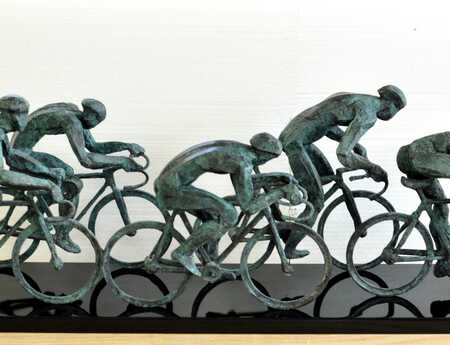
Creating her sculptures using a construction process where she applies cut sections of wood to a welded steel armature and fills in the gaps with epoxy and resin before casting into bronze. Her understanding of form and volume, and her unusual surface of hard-edge planes and use of negative space , combine to achieve a wholly original and convincing result. Powerful and moving with a healthy dose of wit. As a recent critic observed
“The fluency and dynamism of Dickens oeuvre belies a fundamental appreciation not only in the aesthetic of living beings, but an ebullient joy regarding shape itself“.
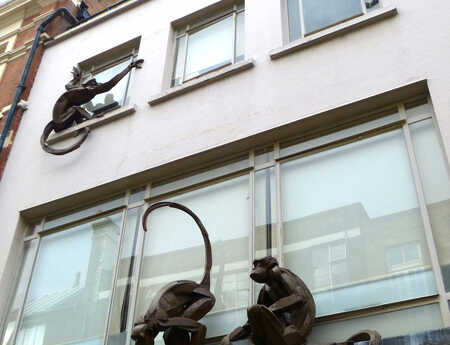
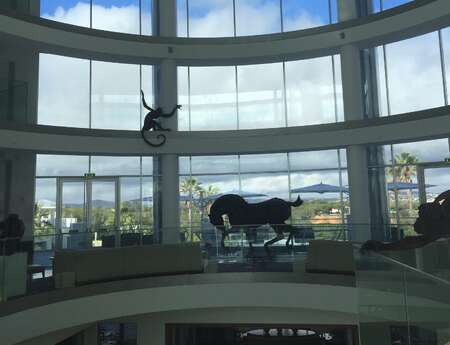
Already popular for her series pieces, such as the cart- wheeling men and weightlifters, for this exhibition Sophie has created an astounding troop of Monkeys, currently clambering up the front of the gallery, and an installation of thirteen rats, who are running around my office, and hanging off the edge of my desk as I write this introduction. I am afraid the Sladmore influence has induced her to move further and further into the natural world, but I offer no apologies, as the results are so remarkable, and popular, with pieces installed in homes and gardens all over the world, her continuing success seems assured.
Gerry Farrell 2014
THE SPACE BETWEEN US
Sophie Dicken’s series of black and sepia drawings exploring the spatial and psychological relationship between interactive figures represent a pivotal moment in her career. As an artist equally at home with figurative and abstract sculpture, she moves fluently between assemblages of wooden elements that are often cast in bronze and potent outline and wash drawings on paper. These drawings exist in their own right as autonomous artworks but might also influence future sculptures. They are at the forefront of a new phase of development.
Figuration, that is representations of human figures and creatures from the living world, has continued to be problematic for even twenty-first century artists since the early Modernists swept it away in the delirious experimentations of the turn of the twentieth century. For many artists and collectors today, especially those who have chosen a path that questions or rejects the primacy of Marcel Duchamp’s once anarchic conceptualism or the cultural profundity of Pop Art, the long shadow of abstract sculptors from Jean Arp and Laszlo Moholy-Nagy to Sol Lewitt, Donald Judd and Carl Andre has endorsed an aesthetic of formal ‘purity’ that requires to be ‘uncontaminated’ by reference to the human condition. Such Utopian abstraction, however, is only one connecting line between modernist pioneers and twenty-first century practice. Alongside it exists that other, equally significant pathway, that of sculptors Constantin Brancusi and Henry Moore, or painters Henri Matisse and Pablo Picasso who move freely between two and three-dimensional expression. These artists maintain the human subject as the significant core of their practice, allowing the rigors of geometry to create an infrastructure that modifies and strengthens their experiments with bodily forms. Brancusi, for example, carved human features as low curved relief planes just lifting out of pure ovoid shapes, while Matisse simplified his figures into either fluent contour curves or cutout silhouettes emphasizing the elasticity of the human body. Sophie works within this tradition, generalizing her slightly elongated but muscular human figures into planar or flowing forms who are certainly not recognizable individuals – their small heads contain no facial features – but are unmistakeably gendered, and engaged in a huge range of interactions: dancing, wrestling, fighting, kissing, banging their heads together, in step and out of step. Hers is very much a contemporary project, but one rooted in knowledge of the universalizing values of classicism through her background in art history. The simplicities of the male figure, for example, suggest the hard geometrical outlines and broad-shouldered proportions of an archaic Greek kouros. And the spaces between couples as defined in her drawings relate to those of her more abstract sculptural assemblages where she shifts abstract forms into strange and unexpected relationships, sundered apart or re-united.
Sophie started this series of square drawings on thick, heavy Bockingford paper during a period when her husband was away for a period of two months pursuing his career as a singer in Australia. This enforced separation led her to start thinking about marital relationships and the notion of ‘the space between’ as both the physical space of separation and the metaphorical divisions between partners or generally between men and women. Initially the drawings explored and gave visual form to her own affection, loneliness and longing annoyance (?) at his absence but an extension into a more generic project was inevitable.
Line drawings almost always belong to seriality. That is to say, the condition of ‘connectivity’ of lines, whether enwrapping contours or abstract scribbles, means that drawings fluently extend themselves. A single line continues to lengthen as long as the hand holding the drawing implement – a pencil or a brush soaked in wash – is not raised from the paper support to end its passage and begin another sequence of movements and interruptions. What cannot be completed or initiated on one piece of paper, suggests the next in a related series. To the extent that drawing is visual thinking, one idea inevitably leads to another. Subject-matter extends itself and grows into themes that demand to be explored. In this sense, Sophie’s project of 24 drawings (??correct?) grew naturally, one drawing leading to another. It was fed by those everyday activities and visual images that stimulate artists often in inchoate and invisible ways. For example, a much-hyped story in the British media about a celebrity break-up and extremely public divorce found formal expression in series of fighting couples. In one drawing the male figure is brutally twisting the nose of his partner, in others an exaggerated dark red arm moves out aggressively towards the shrinking female. On another sheet she retaliates bravely and seizes him by the neck. Sophie’s sculptures, in line with contemporary beliefs are never on pedestals but stand on the ground, or, in the case of her witty animal series, run up corners and angles of real architectural space. By contrast in some of these satirical drawings, the male figures stands on a pedestal or a turn-table, playing God to his accommodating or warring female partner.
In each drawing the couples are united by the quality of the thick, confident pencil contour but the female figure is often differentiated from her darker mate by a paler sepia/pink wash. The spaces between the pair are defined by a heavy black or contrasting sepia infill that transforms the ‘negative’ space into a vibrant topography of unification or separation. Occasionally the thick paper support is attacked, torn or cut, with collaged elements that recall the processes of Sophie’s sculptures, where deliberately sawn pieces of wood or rougher found elements are glued together to form new unities. Each drawing is a complete work, but all of them together form a fascinating narrative that is sometimes humorous, sometimes tender and sometimes about anger and rejection. The series begins with two sepia figures turning their backs on each other, separated by a symbolically dark and widening wedge of alienation. In the final drawing two grey-washed figures turn their backs on the spectator and waltz off into a warm sepia-red future, hand in hand.
Deanna Petherbridge
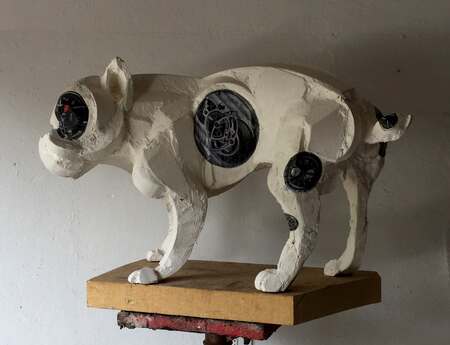
A casual but frequent visitor happening in at Sophie Dickens'studio: the Dulux dog barks; Sophie herself is muffled against the cold, her glasses glint. All the acrobats have now been replaced with pelicans, first the bare but exact armatures, then, in a few weeks, suddenly Pelicans ."It's so cold the paint won't dry on them" Sculpture is a hard profession.
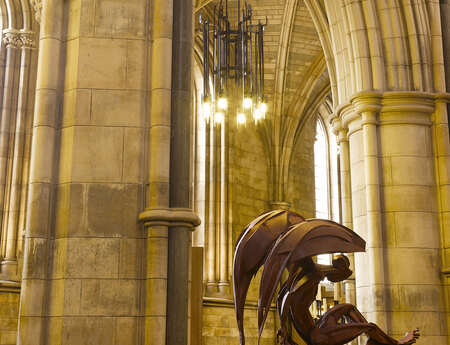
But Sophie Dickens is on a roll. Her "Evangelists" are travelling slowly from one splendid building to another..Southwark Cathedral, St. George's Bloomsbury, showing their affinity with each new building ...they would look splendid in the city. Other large-scale groups
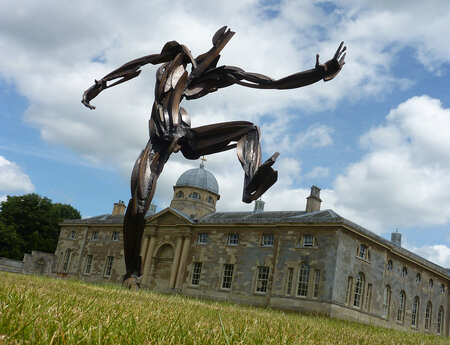
figures are let loose on Moscow, projected on Hong Kong, gambolling in the grounds of Woburn Abbey. The new Pelicans (I am looking over Sophie's shoulder at them) have an authority about the wood-cutting, done on an industrial band-saw; the neck of the nearest one curves up in a figure of 8 with an abstracted eye and then plunges its beak directly down into the centre if its back. Elegant, effortless sculptural
sensibility, they call to mind Pevesner, Vorticism, Gaudier-Brzeska, early John Skeaping. Two honest decades of making , making , making have rewarded Dickens well, with a singular and authorative style which is now beginning to receive its deserved recognition.
If there is a contemporary artist I also call to mind it is Markus Lupertz, and I forsee and ordain that Sophie Dickens will be more and more invited into the mainstream art forum, for so long been
overly dominated with ironic, skimpy art, leaving a generation of young artists without any robust role-model who combines all the honest virtues of hard-won forms, and timeless interest.
Joanna Price
Artist. February 2012
sculptors and helped move our profile away from the pure Animalier to a more modern and interesting place.
Creating her sculptures using a construction process where she applies cut sections of wood to a welded steel armature and fills in the gaps with epoxy and resin before casting into bronze. Her understanding of form and volume, and her unusual surface of hard-edge planes and use of negative space , combine to achieve a wholly original and convincing result. Powerful and moving with a healthy dose of wit. As a recent critic observed
“The fluency and dynamism of Dickens oeuvre belies a fundamental appreciation not only in the aesthetic of living beings, but an ebullient joy regarding shape itself“.
Already popular for her series pieces, such as the cart- wheeling men and weightlifters, for this exhibition Sophie has created an astounding troop of Monkeys, currently clambering up the front of the gallery, and an installation of thirteen rats, who are running around my office, and hanging off the edge of my desk as I write this introduction. I am afraid the Sladmore influence has induced her to move further and further into the natural world, but I offer no apologies, as the results are so remarkable, and popular, with pieces installed in homes and gardens all over the world, her continuing success seems assured.
Gerry Farrell 2014
THE SPACE BETWEEN US
Sophie Dicken’s series of black and sepia drawings exploring the spatial and psychological relationship between interactive figures represent a pivotal moment in her career. As an artist equally at home with figurative and abstract sculpture, she moves fluently between assemblages of wooden elements that are often cast in bronze and potent outline and wash drawings on paper. These drawings exist in their own right as autonomous artworks but might also influence future sculptures. They are at the forefront of a new phase of development.
Figuration, that is representations of human figures and creatures from the living world, has continued to be problematic for even twenty-first century artists since the early Modernists swept it away in the delirious experimentations of the turn of the twentieth century. For many artists and collectors today, especially those who have chosen a path that questions or rejects the primacy of Marcel Duchamp’s once anarchic conceptualism or the cultural profundity of Pop Art, the long shadow of abstract sculptors from Jean Arp and Laszlo Moholy-Nagy to Sol Lewitt, Donald Judd and Carl Andre has endorsed an aesthetic of formal ‘purity’ that requires to be ‘uncontaminated’ by reference to the human condition. Such Utopian abstraction, however, is only one connecting line between modernist pioneers and twenty-first century practice. Alongside it exists that other, equally significant pathway, that of sculptors Constantin Brancusi and Henry Moore, or painters Henri Matisse and Pablo Picasso who move freely between two and three-dimensional expression. These artists maintain the human subject as the significant core of their practice, allowing the rigors of geometry to create an infrastructure that modifies and strengthens their experiments with bodily forms. Brancusi, for example, carved human features as low curved relief planes just lifting out of pure ovoid shapes, while Matisse simplified his figures into either fluent contour curves or cutout silhouettes emphasizing the elasticity of the human body. Sophie works within this tradition, generalizing her slightly elongated but muscular human figures into planar or flowing forms who are certainly not recognizable individuals – their small heads contain no facial features – but are unmistakeably gendered, and engaged in a huge range of interactions: dancing, wrestling, fighting, kissing, banging their heads together, in step and out of step. Hers is very much a contemporary project, but one rooted in knowledge of the universalizing values of classicism through her background in art history. The simplicities of the male figure, for example, suggest the hard geometrical outlines and broad-shouldered proportions of an archaic Greek kouros. And the spaces between couples as defined in her drawings relate to those of her more abstract sculptural assemblages where she shifts abstract forms into strange and unexpected relationships, sundered apart or re-united.
Sophie started this series of square drawings on thick, heavy Bockingford paper during a period when her husband was away for a period of two months pursuing his career as a singer in Australia. This enforced separation led her to start thinking about marital relationships and the notion of ‘the space between’ as both the physical space of separation and the metaphorical divisions between partners or generally between men and women. Initially the drawings explored and gave visual form to her own affection, loneliness and longing annoyance (?) at his absence but an extension into a more generic project was inevitable.
Line drawings almost always belong to seriality. That is to say, the condition of ‘connectivity’ of lines, whether enwrapping contours or abstract scribbles, means that drawings fluently extend themselves. A single line continues to lengthen as long as the hand holding the drawing implement – a pencil or a brush soaked in wash – is not raised from the paper support to end its passage and begin another sequence of movements and interruptions. What cannot be completed or initiated on one piece of paper, suggests the next in a related series. To the extent that drawing is visual thinking, one idea inevitably leads to another. Subject-matter extends itself and grows into themes that demand to be explored. In this sense, Sophie’s project of 24 drawings (??correct?) grew naturally, one drawing leading to another. It was fed by those everyday activities and visual images that stimulate artists often in inchoate and invisible ways. For example, a much-hyped story in the British media about a celebrity break-up and extremely public divorce found formal expression in series of fighting couples. In one drawing the male figure is brutally twisting the nose of his partner, in others an exaggerated dark red arm moves out aggressively towards the shrinking female. On another sheet she retaliates bravely and seizes him by the neck. Sophie’s sculptures, in line with contemporary beliefs are never on pedestals but stand on the ground, or, in the case of her witty animal series, run up corners and angles of real architectural space. By contrast in some of these satirical drawings, the male figures stands on a pedestal or a turn-table, playing God to his accommodating or warring female partner.
In each drawing the couples are united by the quality of the thick, confident pencil contour but the female figure is often differentiated from her darker mate by a paler sepia/pink wash. The spaces between the pair are defined by a heavy black or contrasting sepia infill that transforms the ‘negative’ space into a vibrant topography of unification or separation. Occasionally the thick paper support is attacked, torn or cut, with collaged elements that recall the processes of Sophie’s sculptures, where deliberately sawn pieces of wood or rougher found elements are glued together to form new unities. Each drawing is a complete work, but all of them together form a fascinating narrative that is sometimes humorous, sometimes tender and sometimes about anger and rejection. The series begins with two sepia figures turning their backs on each other, separated by a symbolically dark and widening wedge of alienation. In the final drawing two grey-washed figures turn their backs on the spectator and waltz off into a warm sepia-red future, hand in hand.
Deanna Petherbridge
A casual but frequent visitor happening in at Sophie Dickens'studio: the Dulux dog barks; Sophie herself is muffled against the cold, her glasses glint. All the acrobats have now been replaced with pelicans, first the bare but exact armatures, then, in a few weeks, suddenly Pelicans ."It's so cold the paint won't dry on them" Sculpture is a hard profession.
But Sophie Dickens is on a roll. Her "Evangelists" are travelling slowly from one splendid building to another..Southwark Cathedral, St. George's Bloomsbury, showing their affinity with each new building ...they would look splendid in the city. Other large-scale groups
figures are let loose on Moscow, projected on Hong Kong, gambolling in the grounds of Woburn Abbey. The new Pelicans (I am looking over Sophie's shoulder at them) have an authority about the wood-cutting, done on an industrial band-saw; the neck of the nearest one curves up in a figure of 8 with an abstracted eye and then plunges its beak directly down into the centre if its back. Elegant, effortless sculptural
sensibility, they call to mind Pevesner, Vorticism, Gaudier-Brzeska, early John Skeaping. Two honest decades of making , making , making have rewarded Dickens well, with a singular and authorative style which is now beginning to receive its deserved recognition.
If there is a contemporary artist I also call to mind it is Markus Lupertz, and I forsee and ordain that Sophie Dickens will be more and more invited into the mainstream art forum, for so long been
overly dominated with ironic, skimpy art, leaving a generation of young artists without any robust role-model who combines all the honest virtues of hard-won forms, and timeless interest.
Joanna Price
Artist. February 2012