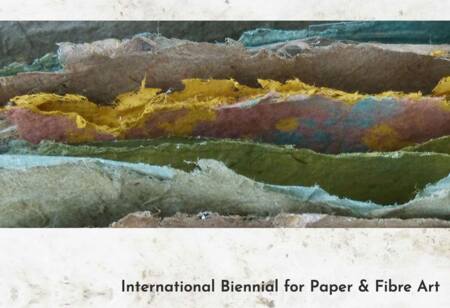
International Biennial for Paper & Fibre Art
The Association Chaîne de Papier is pleased to announce the upcoming 2021/22 Edition of the Paper Fibre Art Biennial event in the exhibition halls at the NTCRI Campus, in Nantou County, Taiwan. Paper & fibre artists from around the world are invited to propose new works for this exciting biennial project.
The programme includes two exhibitions and kozo workshops.
The exhibitions in brief:
Exhibition I – Kozo Contemporary
Theme: Kozo contemporary “Reflecting the soul and the spirit of the maker”
Works accepted: works made from handmade paper with kozo as the main medium.
Exhibition II - Change
Theme: “Change”
Works accepted: works can be made using mixed media techniques. The main material should be natural or recycled fibres. Other natural materials can form part of the work, e.g. wood, clay, metal. Recycled man-made materials or fibres are also accepted.
Exhibition I – Kozo contemporary “Reflecting the soul and the spirit of the maker”
By inviting you to work with kozo fibre from the Broussonetia papyrifera tree, we hope to inspire you to enter into a dialogue with ancient traditions, cultures, art and crafts, which will take you from the past to the present day and into the future.
“Papermaking was invented approximately 105 AD by a Chinese official named Cai Lun and introduced to Japan in 610 AD by Doncho, a Buddhist monk from Korea”.
“The Prince Regent Shotoku found Chinese paper too fragile and encouraged the use of kozo (mulberry) and hemp fibers, which were already cultivated for use in textiles. Papermaking techniques spread throughout the country and, under his patronage, the original process slowly evolved into the Nagashizuki method of making paper, using kozo and neri (a viscous formation aid that suspends fibers evenly in water). These skills have been passed down from generation to generation, producing a paper that was not only functional, but reflecting the soul and spirit of the maker.” ‘The close relationships between the papermaker and his paper and then paper to paper user resulted in washi becoming an integral part of Japanese culture. Traditionally, the making of washi was a seasonal process. Most papermakers were farmers who planted kozo and hemp in addition to their regular crops. The best washi was made during the cold winter months. This coincided with the season when the farmers could not work in their fields and the icy water was free of impurities, which if present could discolor the fibers.”
Yuki Katayama
Not only in Japan, where kozo fibres are used widely for washi, but also in Korea and China, it was traditional for each prefecture to develop its own style of production by master papermakers. In Korea, traditionally hanji paper is made with kozo for many different uses, including clothing. In China, kozo or mulberry paper is used for numerous different calligraphy papers with many regional variations, which differ according to tradition, as well as the individual master papermaker and the climatic conditions. Other important factors include water quality and atmospheric conditions, which influence plant growth and the unique qualities of the plant and fibre, all of which influence the quality of the paper. A master papermaker is fully aware of the importance of these factors, working as one with nature and with the fibre. By combining traditional papermaking techniques using kozo fibre with modern techniques and by applying their individual creativity, artists embark on a tremendous journey into the past and the future. Each artist leaves their mark, their spirit in each sheet of paper they create.
From bark cloth, the earliest known use of paper mulberry fibre, to the finest washi and hanji paper, we perpetuate the ancient tradition and add our own character to the paper of the future.
For this event, we welcome all techniques and forms of art provided that kozo is the main medium.
Exhibition II - Change
The global environmental situation is more critical than ever for man and nature. Scientists have been talking about the ecological dangers for years. Even children around the world and standing up to express their very real concerns about the future. The situation is urgent. The economic frenzy to produce and consume carries on for the benefit of a few and to the detriment of many. If the race continues to target short-term profits, the social impact, the threat to humanity itself and nature will be catastrophic. Profound and sustainable change requires social transformation. The status quo is untenable. As W. B. Yeats wrote a century ago, “Things fall apart. The centre cannot hold”.
The theme of the last edition of the Biennial Paper Fibre Art was Eco-sublime. With this new edition, we invite you to think about the urgent need for change if we are to avoid or at least mitigate ecological disaster.
Challenging the established order, proposing different ways of looking and being are often important features of artists’ work. Art can and must play a major role, encourage us to open our eyes and change our perception of things. Here, two artists from two continents are mentioned briefly, to provide food for thought. The Ghanaian artist, El Anatsui, works with recycled materials and objects that have passed through other people’s hands. The materials have a history and evoke the importance of connections. At the Earth Summit in Rio in 1992, he made a sculpture out of wood called Erosion. The tall imposing sculpture bears inscriptions and symbols from his native Ghana and Nigeria. His decision to chainsaw the work, which left deep cuts, scattered pieces of wood at the base, destroyed the symbols of an ancient language, mirrors the deforestation in Brazil. Thus, he shows the violence of environmental destruction and the erosion of traditional cultures and languages. His monumental “tapestries” are made from bottle tops sown together with copper wire. They evoke the links between Europe, Africa and the United States with commercial trade in alcohol, sugar and slaves. They also represent the walls that are built in order to exclude some people, while they protect others. The tapestries vibrate and shimmer with the colours, diversity and ingeniousness that are specific to Africa. El Anatsui explains that art is a replica of life. As life is not fixed, but changing, he wants his works to be flexible and changing too, to have the capacity to adapt.
The American artist, Chris Jordan, decries mass consumption and the waste that it generates. He photographs waste and makes art works from it, inviting each of us to reflect on our own behaviour. As he shows, we all have a share of responsibility. He is interested in numbers, statistics, which often go beyond our comprehension. For example, the work Whale is composed of images of 50 000 plastic bags, the equivalent number of pieces of plastic floating on every square mile of the world’s oceans. Thus, he transforms data into art, showing how things are linked: the carbon footprint 1 000 miles from where we make our purchases, the social impact 10 000 miles from where we live that was caused by our consumer choices. He photographed young birds that died after ingesting plastic. These images were a precursor to his film Albatross (https://www.albatrossthefilm.com/). The film was screened on World Oceans Day in 2018. It is a hymn to the beauty of this mythical bird. By presenting a man-made tragedy caused by plastic waste, it is also an urgent call for change.
We invite international artists working with paper fibres to create new works of art that challenge the status quo and reflect on the urgent need to act and trigger “change”.
Isis Olivier
TIMELINE
Artists’ call – September 2020
Closing date for entries - 30th April 2021
Notification of selected artists – May 2021
Dates for sending work – selected artists will be notified of dates
Exhibition opening – November 2021
Exhibition closing date - 11th April 2022
For more information and application form: